
Latest News
New Tenant – Sarah Gotheridge
August 19, 2026
Read all about one of our newest tenants Sarah Gotheridge and her 30 year creative journey that led her to Banks Mill
Can you tell us about you and your creative practice?
My creative practice brings together my experience as a designer, maker and curator. I specialise in surface pattern, textile and fashion design, alongside creative and curatorial consultancy for museums, galleries, cultural organisations and other creative businesses.
At the heart of everything I do is a love of thoughtful design and a fascination with the stories objects can tell. Whether I’m developing a textile print, creating a garment, curating an exhibition or helping someone bring a creative idea to life, I approach each project with the same imagination and attention to detail.
My work is multidisciplinary because that’s how I naturally think and create. Ultimately, my business is about using creativity to make things meaningful as well as beautiful, whether that’s an object someone wants to keep and treasure or an experience that stays with them long after they’ve encountered it.
What’s the story behind why you started your business and the journey to where you are today
For more than thirty years, I’ve been designing, making and bringing ideas to life. Central to my work is a fascination with the emotional connections we form with objects: how they hold memories, tell stories and become part of our lives.
That interest began long before my career. I grew up in a working-class council house where creativity was woven into everyday life. My mum, a gilder at Royal Crown Derby, made our clothes and furnishings, while also filling our home with art, books and treasured objects.
She had a gift for arranging collections of pottery, family heirlooms and holiday souvenirs, teaching me that objects derive value not just from what they are worth, but from the stories and memories they carry.
Looking back, I can see how this environment shaped my belief that art and beauty should be accessible to everyone. It also sparked a lifelong fascination with the emotional value of objects, an idea that continues to sit at the heart of my creative practice.
My professional journey began in 1995. Within six months of graduating, I had established my own greeting card business, designing and making cards that were sold through shops and galleries across the UK and America. It was the beginning of a creative path that would take me in directions I could never have imagined at the time.
I later established a textile accessories business, designing and making limited-edition pieces which I sold directly to customers at some of the UK’s leading design-led fairs, including Country Living Islington, Made Brighton and the Craft Festival in Devon. I also designed bespoke textile souvenir gifts for organisations including Kew Gardens.
After many years of self-employment, I returned to education as a mature student and eventually completed an MA in Fashion and Textiles. The MA was a hugely important period creatively because it gave me the freedom to explore ideas that had fascinated me for years, particularly our emotional connections to clothing and objects, the memories they hold and the value those connections give them.
Most recently, I spent four years as Coproduction Curator of Exhibitions and Displays at the National Justice Museum, where I brought together design, objects, storytelling and community collaboration to create exhibitions. Although the medium was different, I realised that many of the ideas driving my work were exactly the same: people, objects, stories and the connections between them.
Today, my practice brings all of those experiences together. I work as a designer, maker and curator, specialising in textile pattern and fashion design alongside creative and curatorial consultancy. Although those disciplines may initially seem quite different, to me they are completely connected by curiosity, storytelling, craftsmanship and my absolute love of creating beautiful things.
What University did you graduate from? What course did you study?
I graduated from the University of Derby in 1995 with an HND in Fashion. A tutor, Myra Gilbert, encouraged me to believe I could run my own design business, and within six months I had launched a greeting card company.
Throughout my career, I’ve been drawn to the intersection of fashion and textiles, seeing them as inseparable parts of the same creative process.
Later in life, I discovered that many of the challenges I had faced during my education were linked to undiagnosed dyslexia. Returning to study at 45 led to this diagnosis, which allowed me to access valuable support and gain a renewed confidence in my abilities.
I went on to achieve First Class Honours in Fashion and an MA in Fashion and Textiles with Exceptional Distinction. These experiences allowed me to bring together my passions for fashion and textiles and continue to shape my creative practice today.
Returning to education gave me the opportunity to recognise and value the way my mind naturally works rather than measuring myself against the things I found difficult. It confirmed something that, in many ways, I’d known instinctively all along: visual language is my language. It’s how I make sense of ideas, how I tell stories and how I communicate with the world.
How will being based at Banks Mill help your business?
Having a studio at Banks Mill feels like the perfect next chapter in my creative life.
After four years working within a museum environment, having a dedicated studio gives me the opportunity to immerse myself in my own creative practice again. I’m incredibly excited about having somewhere I can experiment, make, think and surround myself with the work and ideas that inspire me.
Being part of Banks Mill also means being surrounded by other artists, designers and makers. I’m looking forward to the conversations, collaborations and unexpected connections that can happen when creative people work alongside one another.
It also gives me a professional base from which to develop my creative and curatorial consultancy work, meet clients and grow the different strands of my practice.
For me, Banks Mill isn’t simply somewhere to work. It’s a place where I can bring together everything I’ve learned while giving myself the space to discover what comes next.
What other work experience, support or training have you gained that’s relevant to what you’re doing now?
I’ve worked across the creative and cultural industries for more than thirty years, and the breadth of that experience is something I now see as one of my greatest strengths.
I’ve been self-employed for a significant part of my career, so I understand both the creative and practical realities of turning ideas into something people want to buy or commission.
Alongside running my greeting card and textile businesses, I’ve worked as an Interior Textiles Stylist and managed touring exhibition programmes, including projects delivered at Premier League football stadiums. I’ve worked across design, styling, product development, exhibitions and events, managing projects from the initial idea through to installation and delivery.
For ten years, I also taught creative workshops and dressmaking classes, sharing my skills and encouraging others to develop their own creativity and confidence in making. Teaching added another dimension to my practice and gave me a real appreciation for the joy that comes from helping someone discover what they are capable of creating for themselves.
More recently, as Coproduction Curator of Exhibitions and Displays at the National Justice Museum, I developed and delivered exhibitions involving artists, community organisations and people with lived experience of difficult and challenging subject matter. Working with people who were often sharing deeply personal experiences required sensitivity, empathy and trust, and an understanding of the responsibility involved in translating those experiences into an exhibition. That role strengthened my skills in creative direction, exhibition design, storytelling, project management, accessibility and co-
production, while reinforcing my belief in the importance of creating work that allows people to feel heard and their stories to be represented with care and integrity.
When I look across my experience, I’ve worked at very different scales, from designing a single greeting card or textile print to creating entire exhibitions and environments.
I love that variety. I’m happiest when I’m solving creative problems, bringing seemingly disparate things together and finding a way to make the final result both meaningful and beautiful.
What are you working on in the studio now?
Right now, I’m curating my creative space. I’m surrounding myself with work from different stages of my creative life and using it as a starting point for what comes next. I’m rediscovering drawings, photographs, textile samples, garments and ideas and beginning to see new connections between them.
There were so many creative threads and ideas that developed during my MA that have effectively been on hold while I spent the last four years immersed in my work at the museum. I’m incredibly excited to have the opportunity to pick those threads up again.
For me, creativity has always been about exploration. I love photographing, sketching, collecting, researching, experimenting with colour, pattern and materials and following an idea simply because I’m curious to discover where it might lead.
Some ideas become finished pieces, others lead somewhere completely unexpected, and some simply spark the next idea. That’s the part of the creative process I love.
I’m also beginning to think about my upcoming exhibition at Banks Mill in May next year. I’m incredibly excited by the prospect of curating an exhibition of my own work and bringing together my experience as both a designer and a curator. It will give me the opportunity to think not only about the individual pieces I want to create and show, but about how they come together to tell a story and how I want people to experience the work as a whole.
Being back in a studio feels a little like coming home. I’m surrounded by things I’ve made, ideas I’ve explored and reminders of where I’ve been creatively, but I’m looking at all of them with fresh eyes and thinking about where they might take me next.
Can you tell us a bit about your work, techniques and how long a piece takes to complete.
My work is very personal. I’m fascinated by the stories objects tell and by the emotional relationships we form with the things in our lives. An object can appear completely ordinary to somebody else but be incredibly precious to us because of the person, place or memory we associate with it. That idea became particularly important during my MA, where I explored emotional connection and value: why we keep certain objects, particularly clothing, and how they can become repositories for memories and personal histories. I find it fascinating that simply seeing or touching something can transport us back to another time, place or person.
That emotional connection informs the way I approach design. My inspiration can come from landscapes, photographs, family histories, archives, clothing, everyday objects, colour or texture. I photograph, draw, collect, research and experiment, gradually allowing ideas to develop into patterns, textiles and garments.
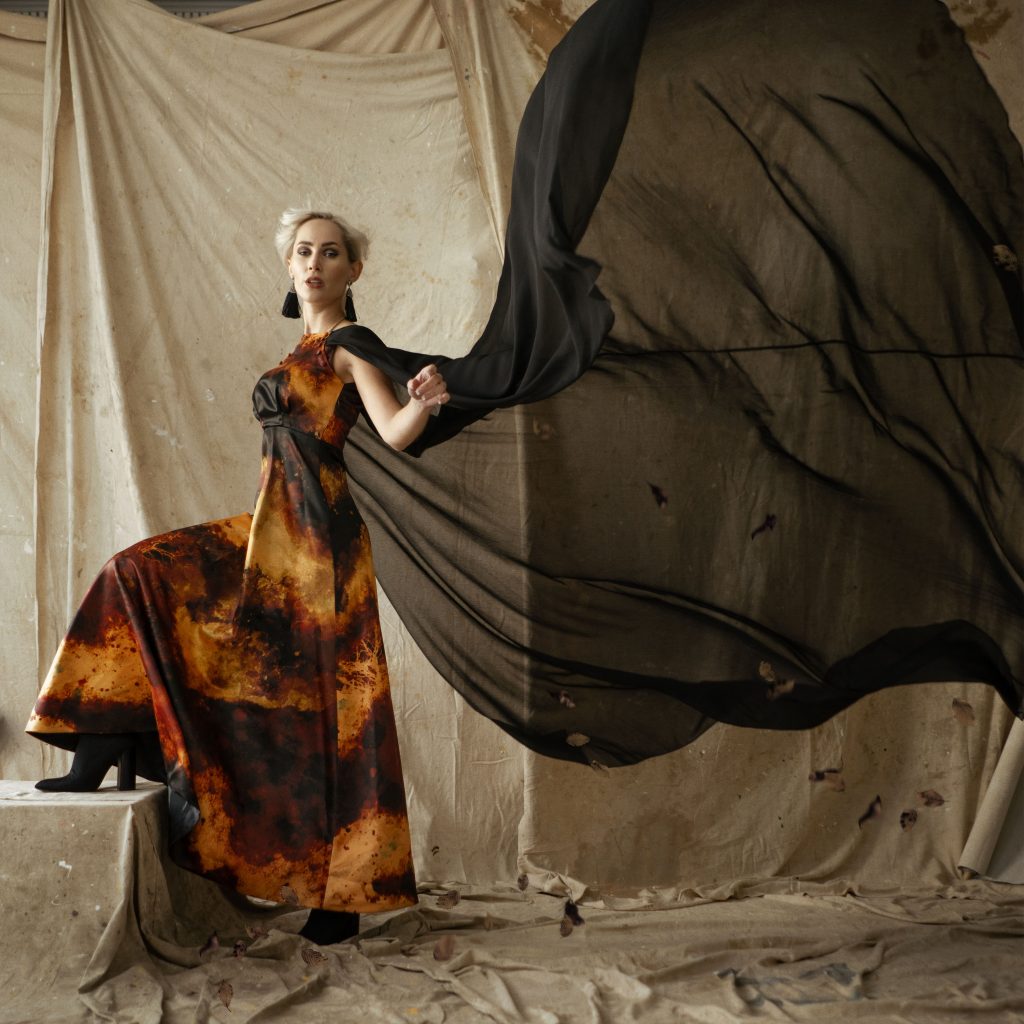
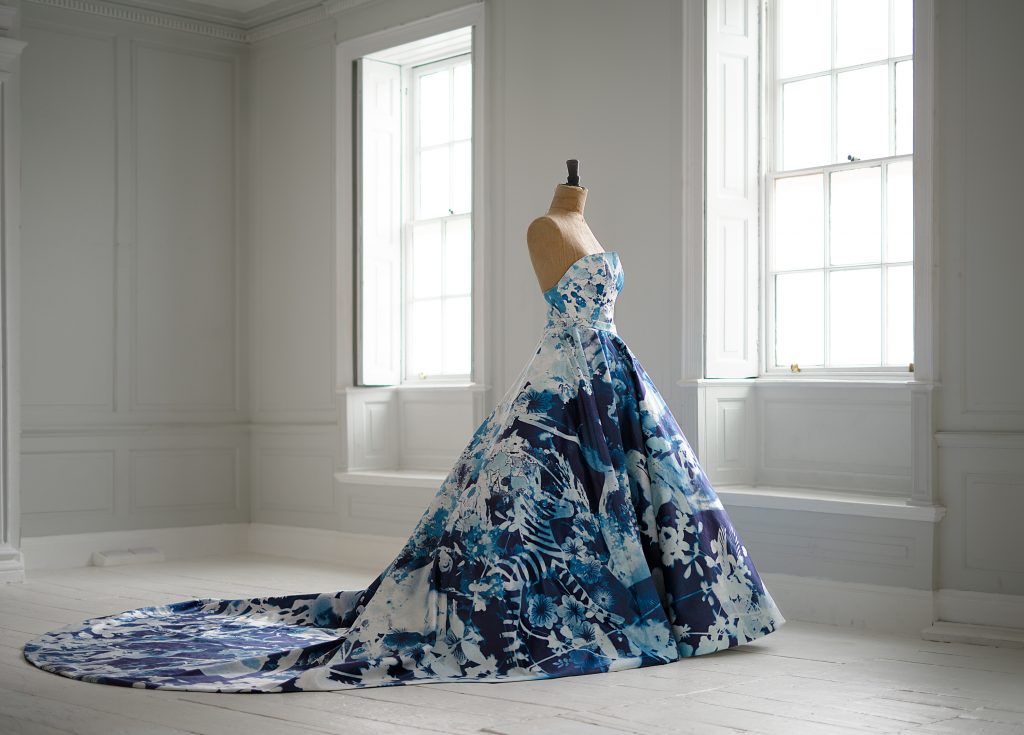
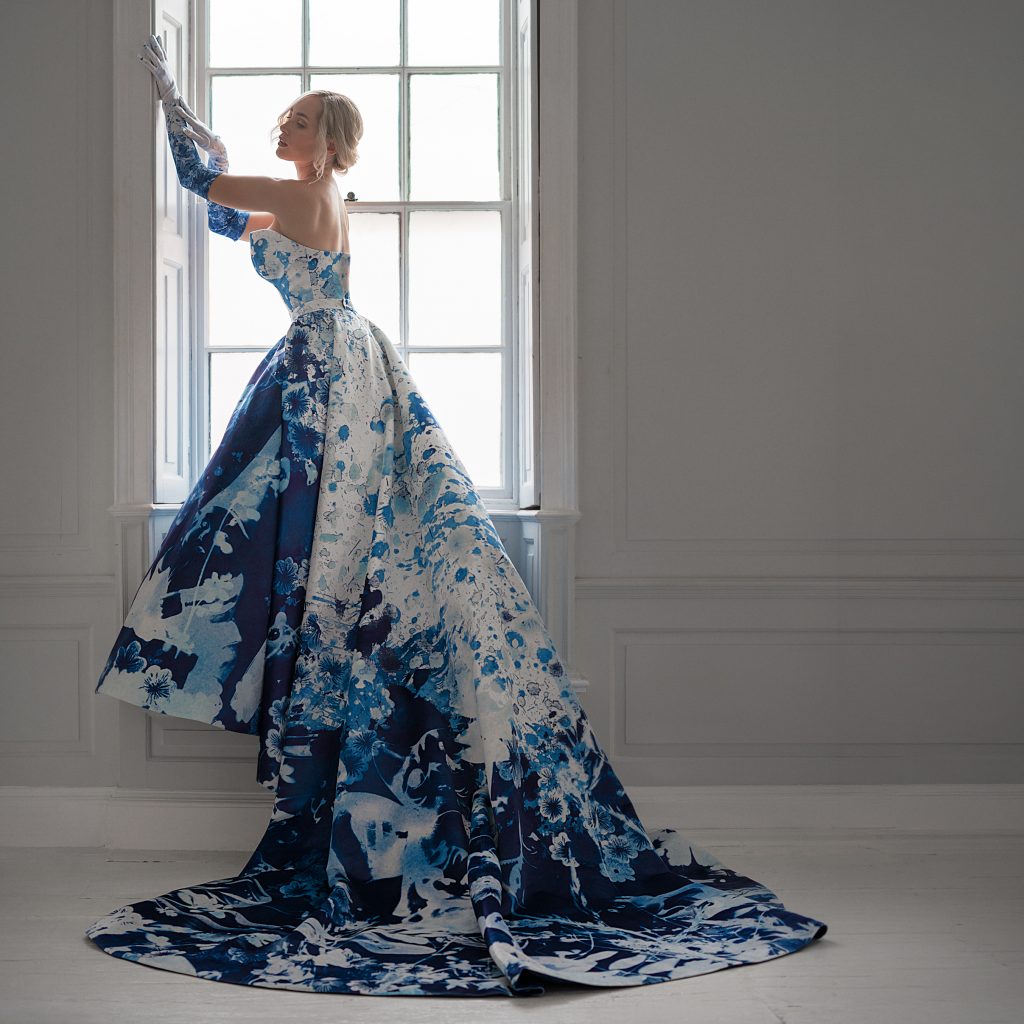
I’m currently returning to cyanotype, a photographic printing process I first discovered while studying for my MA. Covid meant that for a significant part of the course we couldn’t access the university studios, so I had to become resourceful and find ways of creating work from home. Cyanotype gave me a wonderfully immediate way of experimenting with light, objects, silhouettes and composition, and I began using the process to create imagery that could be developed into surface pattern. I’m now revisiting the technique in my studio and exploring where I can take it next. I work across traditional making and contemporary digital processes, and I particularly love the point where surface pattern meets fashion, thinking not only about the print itself but how it will interact with the shape, construction and movement of a garment.
Interestingly, I don’t see designing a surface pattern and curating an exhibition as being particularly different creatively. Both are about bringing individual elements together and arranging them in a way that creates something greater than the sum of its parts. I’ve always had a natural eye for composition. Whether I’m working with motifs on a textile or objects within an exhibition, I’m instinctively considering placement, scale, contrast, repetition and the visual relationships between things.
Ultimately, I’m arranging things to make them look beautiful, creating balance and aesthetic cohesion while allowing each individual element to contribute to the whole. I think that’s why moving between design and curation has always felt so natural to me. The scale and context may change, but I’m using many of the same creative instincts. That same instinct for experimenting, arranging and refining also means it’s difficult to put a standard timescale on my work. The creative process is rarely linear. An idea might develop quickly, or it might sit quietly in the background for months, sometimes years, before another thought, image or object suddenly gives it a new relevance and everything begins to fall into place.
I enjoy allowing ideas that time to evolve. For me, making is a process of looking, responding and refining: experimenting with possibilities, changing direction when something unexpected happens and knowing when all the individual elements have finally found the right relationship with one another. Perhaps that’s why I become so absorbed in what I do. There’s a moment when something that began as a collection of separate thoughts, images, colours or objects suddenly feels resolved and becomes a coherent whole. Whether that’s a surface pattern, a garment or an exhibition, that moment of connection is what I’m always searching for.
For me, that’s where the real joy of creating lies.
What are your plans for your business over the next 12 months?
Over the next twelve months I want to develop new work around surface pattern, textiles and fashion, returning to some of the ideas that emerged from my MA and seeing how they evolve through my current practice. My exhibition at Banks Mill in May will give me a real focus for that work and an opportunity to bring my design and curatorial experience together in a very personal way.
Alongside my own practice, I want to establish my creative and curatorial consultancy, drawing on my experience of exhibitions, museums, storytelling, co-production and design to work with museums, galleries, cultural organisations and other creative businesses.
I also want to remain open to where the work takes me. Some of the most interesting opportunities in my career have come from following an idea or allowing one discipline to influence another, and I want to create the space for that to continue.
Is there anything else you’d like to share as your start your journey at Banks Mill?
I’ve never been someone who wants to stay in one creative lane. Every stage of my career has added another layer to the way I think and work as a designer, and I love allowing those different experiences to inform one another. The thread running through all of it is curiosity and a love of making.
I still get genuinely excited by the beginning of an idea: a photograph, a colour combination, an object, a piece of fabric or something completely unexpected that makes me think, I wonder what I could do with that? Because ultimately, I’ve always believed that the objects we make and keep become part of our own stories. I want to create beautiful things that people connect with, value and want to live with, objects that might, in time, become part of their stories too.
SHARE THIS